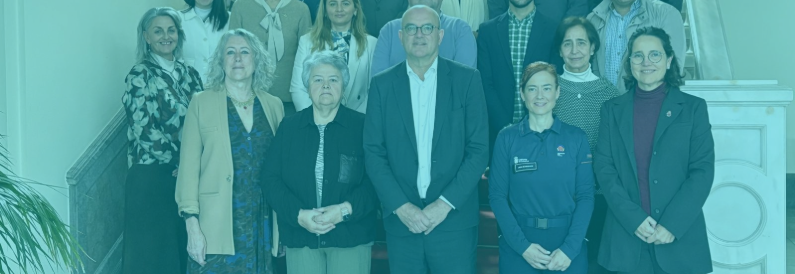
Pilar Vera, the Air Crash Victims’ Families’ Federation International (ACVFFI) and of the Association of Affected Passengers of Flight JK5022, delivered the closing remarks at the Training Conference for the Consular Corps in the Canary Islands. The conference focused on providing on assistance to air crash victims and their families. The event was organised by the Emergency and Civil Protection Service of the Spanish Government Delegation in the Canary Islands.
Representatives of the accredited Consular Corps in the Canary Islands, the Emergency Services of the Government of the Canary Islands, AENA and the Government Delegation attended the event, where they presented the existing regional and national regulations concerning assistance to victims and their families in aviation disasters.
International Framework: ICAO’s Key Documents on Victim and Family Assistance
Regarding European and international regulations, Pilar Vera provided a detailed and comprehensive explanation of the ICAO Policy on Assistance to Victims and Families, along with the processes undertaken since 2010 to develop it. This was a significant achievement, as it meant that the voices of victims and families were heard for the first time within the International Civil Aviation Organization (ICAO). She also noted that only a very small number of ICAO’s 193 Member States have incorporated this global assistance policy into their internal regulations, although Spain passed the USOAP audit in 2021 following consistent efforts to achieve compliance.
She highlighted the following ICAO documents:
- ICAO Annex 9, which sets out binding obligations for States and recommendations for airports and airlines regarding facilitation and assistance.
- Document 9998, defining the international policy on assistance to victims and families.
- Document 9973, an operational manual that develops Doc 9998 and explains in practical terms how assistance standards should be applied.
ACVFFI’s Historical Experience and the Importance of Preparedness
Pilar Vera summarised the historical journey that she undertook together with the late President of the U.S. victims’ association, between 2010 and 2013 at ICAO, which would not have been possible without the invaluable support of the Chair of the NTSB. Their goal was to ensure that ICAO committed itself to supporting victims and families affected by air accidents. Since ICAO’s work revolves around people, it was unacceptable that victims and their families were overlooked in the event of an air tragedy. She described those three years of work as “bringing light to the darkness” , although she herself has spent more than 17 years working in Spain and internationally to ensure that the voices of victims and their families are not only heard and reflected in applicable regulations.
She emphasised that victim and family assistance rests on three pillars: States, Airlines, and Airports. She strongly urged the consular representatives to encourage their States to support to their citizens by implementing the ICAO Policy on Assistance to Victims and Families — a document approved by the consensus among all Member States at the 38th ICAO General Assembly.
Preparedness Is Always Better Than Improvisation
Preventing and preparing for an aviation disaster is always less costly, both in human and economic terms, than reacting chaotically and disorganisedly once a tragedy occurs. Victim and family assistance cannot be improvised. Compliance with national and international regulatory frameworks is the only way to strengthen emergency systems, reduce additional suffering and improve public safety.